
We are proud to announce the publication of a new peer-reviewed article co-authored by our Chairman and CEO, Dr. Nick Barua, in the internationally recognised journal Sensors (MDPI). This publication marks another significant milestone in AN Holdings Co.’s mission of driving technological foresight and contributing to a safer global environment.
ABOUT THE RESEARCH
Reconstructing What Is Lost at the Scene
A pedestrian–vehicle collision is a physical event that encodes a complete kinematic record — trajectory, impact forces, throw distance, and the sequence of contact events. Yet by the time a forensic investigation begins, this record has vanished. The new framework directly addresses this challenge, treating post-collision reconstruction as a rigorous state-estimation problem governed by classical physics.
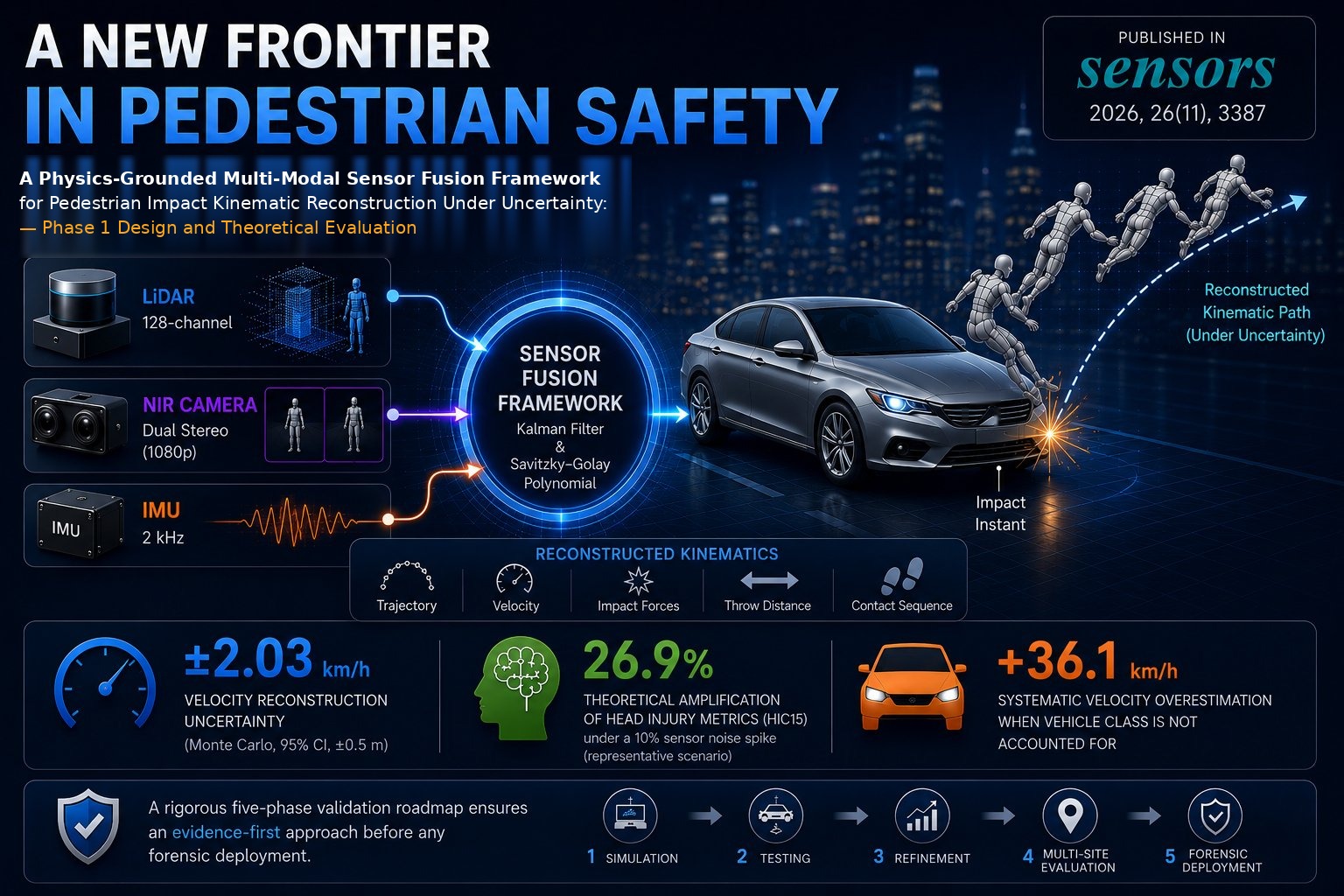
The article, titled “A Physics-Grounded Multi-Modal Sensor Fusion Framework for Pedestrian Impact Kinematic Reconstruction Under Uncertainty: Phase 1 Design and Theoretical Evaluation,” has been published in Sensors, Volume 26, Issue 11 (DOI: 10.3390/s26113387). It presents a Phase 1 design for a multimodal sensor fusion and signal-processing architecture that fuses a 128-channel LiDAR, 1080p NIR stereo cameras, and a 2 kHz IMU — all aligned through Kalman filtering and Savitzky–Golay polynomial differentiation — to reconstruct the kinematics of a pedestrian collision from residual scene observables.
“Pedestrian–vehicle collisions produce a rich kinematic record that is entirely lost by the time a forensic investigation begins. Recovering this record constitutes a state-estimation problem.” — Abstract, Sensors 2026
KEY FINDINGS
What the Phase 1 Evaluation Demonstrated
|
±2.03 km/h |
velocity reconstruction uncertainty under expanded Monte Carlo simulation conditions (±0.5 m throw-distance measurement error) |
|
26.9% |
theoretical amplification of head injury metrics (HIC15) under a 10% sensor noise spike — quantifying the critical importance of noise-optimal pre-filtering |
|
+36.1 km/h |
systematic velocity overestimation when vehicle class is not accounted for, underscoring the need for parameterised reconstruction models |
A structured five-phase validation roadmap is presented, progressing from finite-element simulation through to independent multi-site replication before any forensic deployment is proposed — a demonstration of the rigorous, evidence-first approach that characterises this research programme.
RESEARCH COLLABORATION
A Continuing Partnership with Shiga University of Medical Science
This publication continues the distinguished collaboration between Dr. Nick Barua and Professor Masahito Hitosugi, M.D., Ph.D., Professor of Legal Medicine at Shiga University of Medical Science, Japan. Professor Hitosugi is a globally recognised forensic pathologist whose expertise in injury biomechanics and trauma analysis ensures the framework is grounded in clinically and medico-legally meaningful outcomes.
This paper builds directly upon the authors’ prior work — the Advanced Falling Object Detection System (AFODS), published in Vehicles (MDPI) in December 2025 — extending that prospective real-time safety platform into the complementary domain of retrospective forensic reconstruction. Together, the two frameworks form a coherent, physics-grounded architecture addressing both the prevention and the investigation of pedestrian–vehicle collisions.
WHY THIS MATTERS
Physics-Based Transparency for Modern Evidence Standards
Forensic reconstruction has historically relied on expert pattern recognition. While this is not incorrect, it lacks two properties that evidence standards increasingly require: an explicit, auditable uncertainty budget and a principled basis that can be independently evaluated. The new framework provides both — transforming qualitative expert judgment into a physics-grounded, quantitatively bounded output at every stage of the reconstruction pipeline.
In practice, this matters enormously. Incorrect vehicle-class assumptions can produce theoretical velocity errors exceeding 36 km/h — large enough to fundamentally alter collision-reconstruction conclusions and, ultimately, outcomes in legal proceedings. The framework directly addresses these systematic risks through vehicle-class parameterisation and end-to-end uncertainty propagation.
Read the Full Paper (Open Access): https://doi.org/10.3390/s26113387